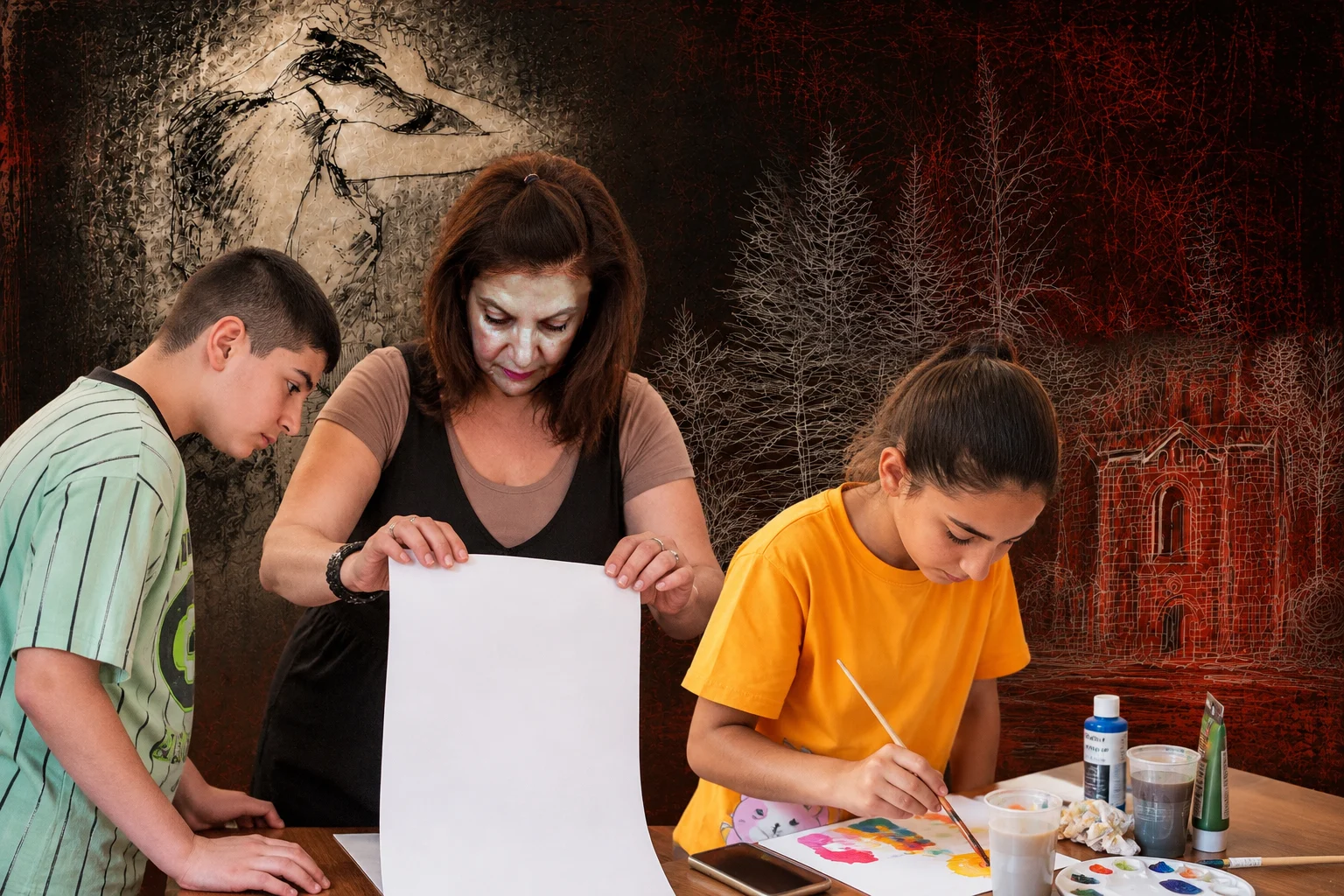
“YEREVAN TO THE REGIONS”: Expanding Cultural Horizons Through Art
31.10.2026
The graphic heritage of Garzou and Jean Jansem in Meghri, Kapan and Goris
Art knows no boundaries. It brings together different eras, cultures and geographical spaces, becoming a unique means of dialogue, discovery and the preservation of identity. This very idea lies at the heart of the cultural programme “YEREVAN TO THE REGIONS”, initiated by the Yerevan Museum of Modern Art with the support of the Yerevan Municipality. In 2026, the programme reached another important milestone in Armenia’s Syunik Province.
At its core is an essential conviction: outstanding cultural values should be accessible not only to residents of the capital but also to people throughout Armenia. The decentralisation of cultural life, strengthening creative ties with the regions and making art accessible to wider audiences are among the programme’s principal objectives.
The history of “YEREVAN TO THE REGIONS” dates back to 2021, when its first phase was launched with the support of the Ministry of Education, Science, Culture and Sport of the Republic of Armenia and the Embassy of France in Armenia. The initial programme was implemented in Lori and Shirak Provinces, attracting considerable interest from local residents, art enthusiasts and the cultural community. In 2026, the initiative continued in Syunik with new content and an important cultural mission.
The great names of Franco-Armenian art in Syunik
During September and October, the exhibition programme entitled “The Great Masters of Franco-Armenian Graphic Art” was presented in Meghri, Kapan and Goris, introducing audiences to the artistic legacy of two prominent representatives of 20th-century Franco-Armenian art: Garzou (Garnik Zulumyan, 1907–2000) and Jean Jansem (Hovhannes Semerdjian, 1920–2013).
Approximately 40–60 graphic works selected from the collection of the Yerevan Museum of Modern Art offered regional audiences the opportunity to encounter firsthand the distinctive artistic vision of these internationally renowned artists.
Although their art developed within the European cultural environment, the deeper roots of Garzou’s and Jansem’s creative identities remain connected to Armenian heritage, memory and spirituality. Their works bring together Armenian cultural memory, European artistic thought and universal human themes. This dialogue takes on particular significance when their legacy is presented in different communities across Armenia, allowing local audiences to discover it from new perspectives.
Garzou’s graphic language is distinguished by imaginary spaces, architectural outlines, mysterious figures and distinctive linear compositions. In his works, reality seems to transform into a dreamlike world, where forms and spaces are shaped by the artist’s inner vision.
Jansem’s art, in turn, is centred primarily on the human figure, emotional experience and psychological depth. His drawing is often restrained yet remarkably expressive. Through minimal artistic means, he conveys the drama of human existence, vulnerability and inner silence.
The juxtaposition of these two artists’ works revealed the broad expressive possibilities of graphic art and introduced viewers to two distinct yet complementary artistic worlds.
To enrich the exhibition experience, the displays were accompanied by music composed by prominent Franco-Armenian musicians, including Charles Aznavour, Michel Legrand and Georges Garvarentz. Visitors also had the opportunity to watch a film about the artists’ lives and creative journeys, featuring English subtitles and based on archival materials from Armenian Public Television. An illustrated booklet was also prepared to provide additional historical and artistic context.
Art as an opportunity not only to observe but also to create
An important component of the programme was its educational dimension. The workshops entitled “Monotype and Mixed Media: Let’s Create Together”, led by artist Lusine Naghdalyan, were designed for children and young people.
They transformed the exhibition experience into a direct creative process, allowing participants not only to discover the art of Garzou and Jansem but also to experiment with the expressive possibilities of graphic techniques themselves.
Participants were introduced to the main types of printmaking, the monotype technique, its artistic characteristics and creative potential. During the practical sessions, they applied their newly acquired knowledge and created their own artworks.
In this respect, the workshops were important not merely as a means of transferring artistic skills, but also as an opportunity to encourage creative self-expression, develop aesthetic sensibility and establish a personal connection with art.
At the end of the workshops, participants received souvenirs featuring reproductions of works by Garzou and Jansem, including postcards, pens, bookmarks, notebooks, tote bags and other items. In this way, the encounter with art continued beyond the exhibition space, becoming a lasting memory and part of everyday cultural life.
From Meghri to Goris: A cultural response that exceeded expectations
The three locations of the programme—Meghri, Kapan and Goris—became more than exhibition venues: they evolved into platforms for active cultural dialogue.
In all three cities, the initiative received an exceptionally warm welcome and an enthusiastic public response. The opening events, active visitor participation, children's excitement and strong interest in art once again demonstrated the considerable demand for and importance of such initiatives in Armenia's regions.
Particularly significant was the fact that the programme extended beyond the traditional exhibition format. It fostered cultural dialogue between generations, contributed to children's aesthetic education, broadened public engagement with art and strengthened cooperation between cultural institutions in the capital and the regions.
Each city, with its own atmosphere, audience and response, added a distinctive dimension to the project, highlighting the cultural potential of Armenia's regions and the public's readiness to engage with high-quality artistic initiatives.
Cultural decentralisation as a continuing mission
The “YEREVAN TO THE REGIONS” programme once again demonstrated that making cultural heritage accessible should be understood not simply as presenting artworks to the public, but as a process of creating new knowledge, interest and cultural connections around them.
For the Yerevan Museum of Modern Art, the initiative also provided an important opportunity to expand the public reach of its collection, explore new formats of museum engagement and develop partnerships with regional cultural institutions.
Presenting the art of Garzou and Jansem in Syunik carried symbolic significance. The creative legacy of these two great Franco-Armenian artists crossed geographical distances and returned to its historical and cultural roots, meeting new audiences and inspiring new interpretations.
The enthusiastic and exceptionally strong response in Meghri, Kapan and Goris demonstrated that interest in art is not determined by geography. What it requires is accessibility, initiative and consistent cultural engagement.
“YEREVAN TO THE REGIONS” is more than an exhibition programme. It is a cultural bridge between the capital and Armenia’s regions, through which art becomes a living force for public dialogue, education and the creation of a shared cultural space.