
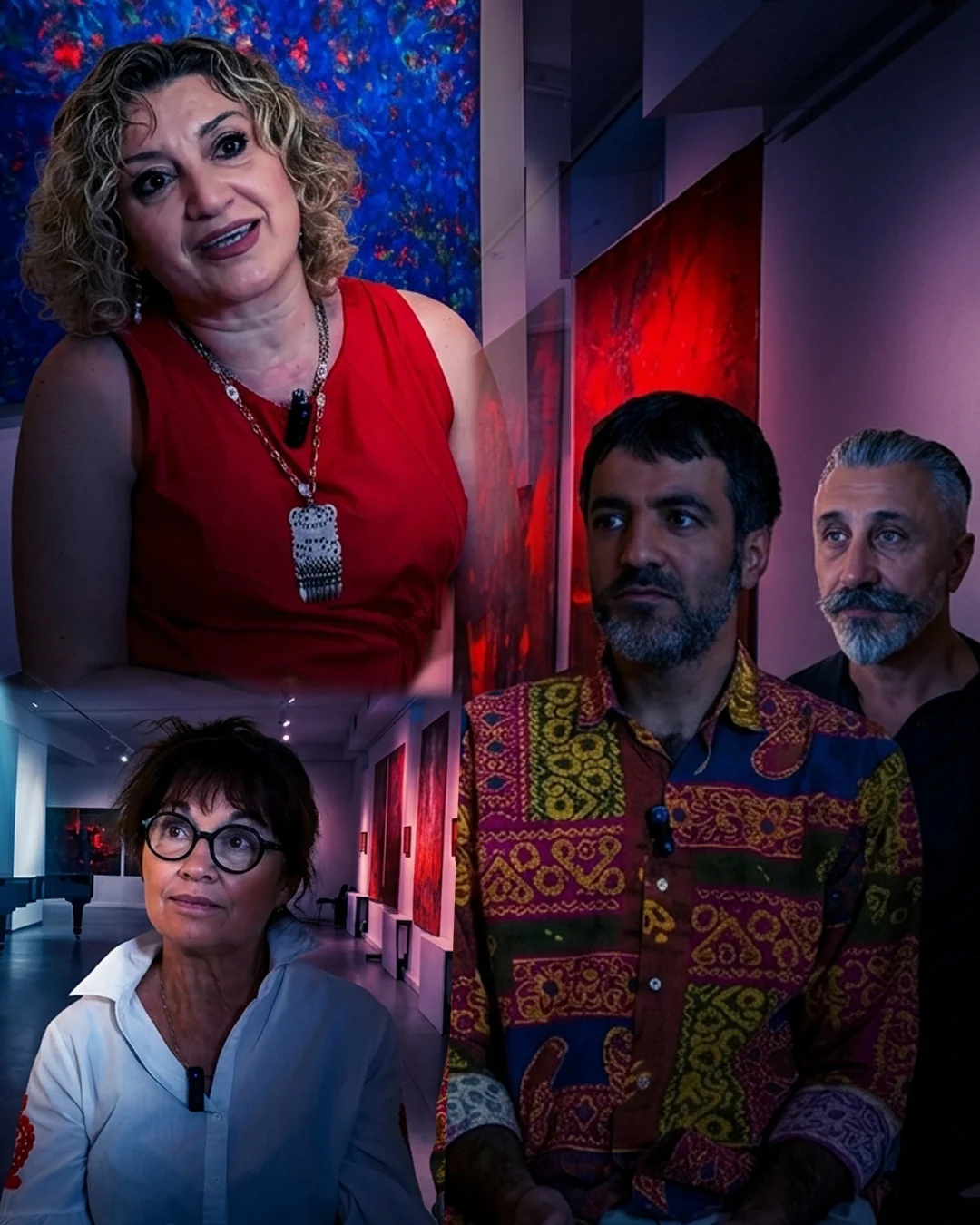
Opened on September 17 at the Yerevan Museum of Modern Art, the group exhibition Eden brings together the creative worlds of three artists, creating a space where memory, homeland, love, and the longing for return intertwine.
Here, Eden is neither a specific place nor a particular period of time, but an inner state—a space existing between dream and revelation, between the visible and the unseen. It is a place that can be reached not so much through physical movement as through memory, sensation, and art.
The exhibition is built upon a dialogue between different artistic languages. The individual identities of the three artists do not dissolve into a single aesthetic; rather, they retain their distinctiveness while forming a cohesive visual environment. This encounter of differences becomes one of the exhibition’s essential propositions—one concerning diversity, freedom, and coexistence.
In Eden, homeland is presented not merely as a geographical territory, but as an inner and collective landscape. It lives within memory as a sense of belonging, a trace of childhood, a lost or rediscovered place. From this perspective, homeland is no longer simply a location on a map, but a part of one’s identity.
From this emerges another central movement of the exhibition: return. Yet this return is not simply a return to the past. It is a journey toward one’s roots, toward the experiences and sensations that have shaped both individual and collective memory. Here, art becomes a means of reliving and reinterpreting those experiences.
The idea of love, too, extends beyond the boundaries of personal emotion. It becomes a force of connection and belonging—the force that allows memory to endure, the lost to be rediscovered, and one to remain connected to one’s own world.
The title Eden acquires an additional resonance through its Gyumri dialect interpretation: “there,” “that one”—a place that is at once distant and familiar. That “there” may be a childhood home, a homeland, a lost time, or one’s inner world. This ambiguity gives the exhibition’s central idea a more intimate and living dimension.
Ultimately, Eden is a journey toward the point where personal memory meets collective experience. Here, art does not merely speak of loss, homeland, or return; it creates a space in which these can be felt.
Perhaps Eden is precisely the place that can never be reached completely. Yet through art, it becomes possible to approach it once again—to remember, to feel, and to return to one’s roots.