
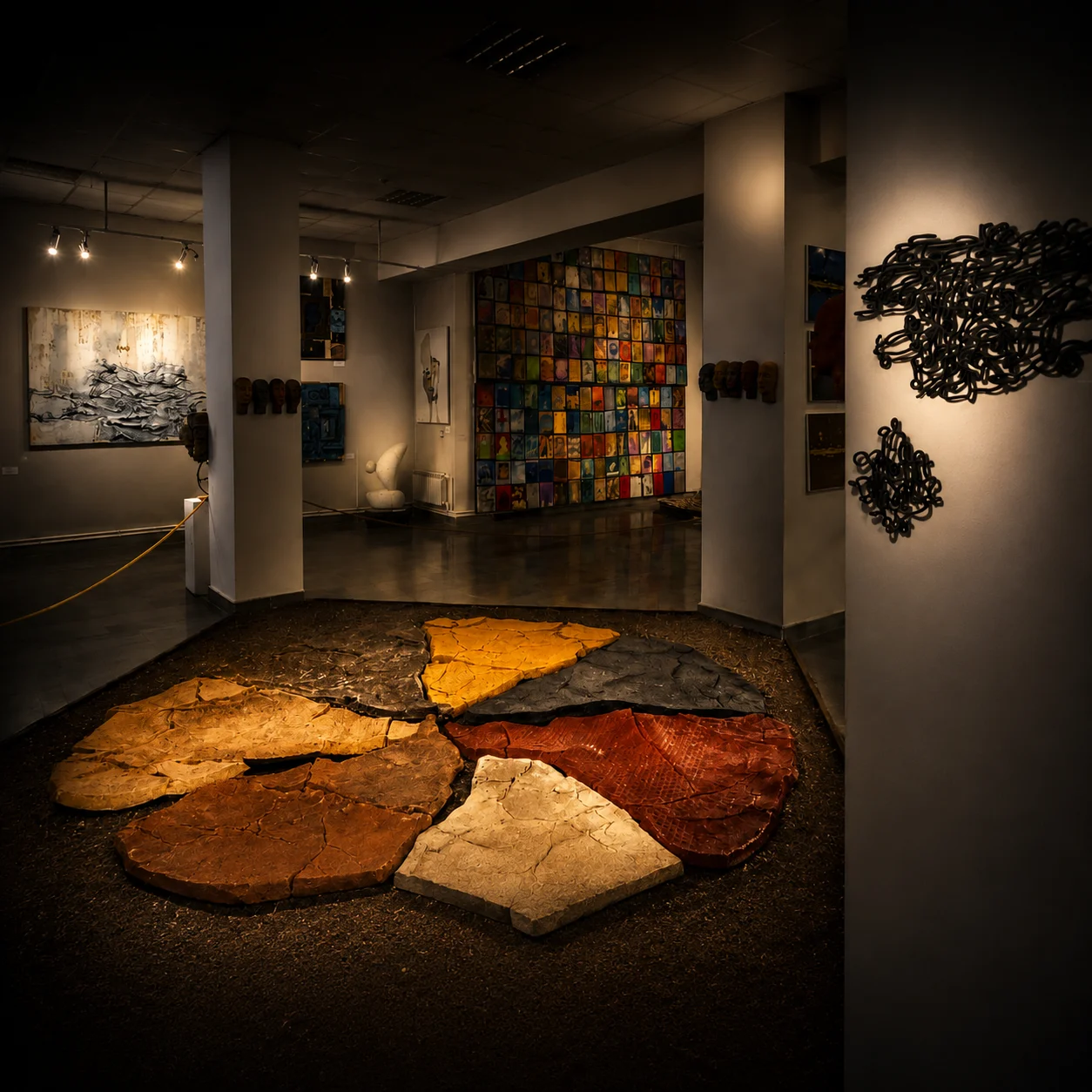
The work is based on the story of an Armenian family, reconstructed through the memories of a refugee. These memories encompass the family’s entire journey of exile from 1915 to 1946, transforming a personal biography into a testimony that conveys the human dimension of historical events.
Through the story of a single family, Taramarca explores the experience of being uprooted, emphasizing the deep bond between people and their homeland, culture, and collective memory. At the same time, the work considers displacement as a universal human phenomenon, extending beyond the boundaries of a particular historical period or geographical location. The Uprooted raises questions about what happens to identity and memory when a person is forced to leave their home, and how the desire to rediscover or reconnect with one’s roots emerges.
The installation consists of two interconnected parts.
“The Family Circle” presents seven members of the family, each accompanied by their individual story. Their personal memories come together to form a larger narrative, creating a collective family biography. The family thus becomes not only the bearer of history but also a space through which memory is preserved and transmitted from one generation to another.
The second major component of the installation is a series of faces, which expands the conceptual framework of the work. The faces embody the universal problem of displacement and the forced movement of people, connecting the installation not only with the past but also with the realities of the contemporary world. Here, an individual story gradually becomes a symbol of collective memory and a shared human experience.
The thematic and visual elements of the installation are made of earth. The choice of material carries a profound symbolic meaning: earth becomes at once an image of homeland, roots, memory, and belonging. What can be physically taken away from a person can nevertheless remain preserved within memory and identity.
Thus, The Uprooted transforms personal memory into a cultural and universal statement. Josette Taramarca’s work not only tells the story of a displaced family but also reflects on the meaning of home as a unity of place, memory, culture, and identity. The installation reminds us that while roots can be physically severed, a person’s connection to their land, history, and memory can endure even across great distances.