
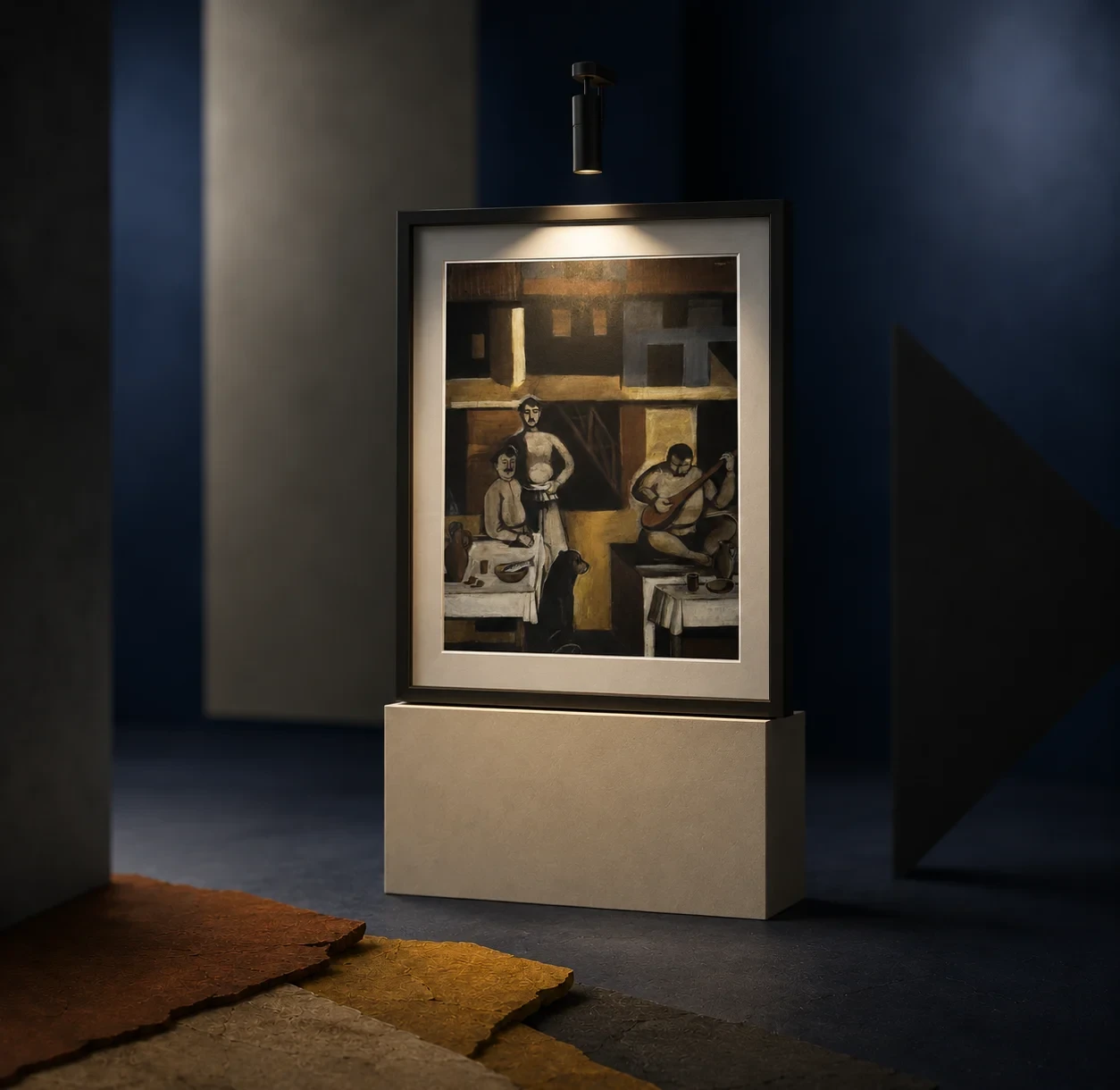
Thus, Karalyan introduced a new genre into Armenian painting — the genre of memory. This artistic direction was later continued by Hakob Ananikyan and Vagharshak Elibekyan. Just as memoirs are highly valued in literature, they are equally natural and justified in the visual arts. Particularly valuable is the work of an artist who lived through the transition from the age of horse-drawn carts and kerosene lamps to the dawn of the space era, and who was able to look back on the past from the vantage point of his own time.
Karalyan is a painter of substance. He never approaches his subject matter formally; the form of each work is determined by its plot and the motif that captures his attention. This is the principal strength of his art. His paintings are distinguished by profound imagery, giving each canvas a memorable and distinctive character. For Karalyan, the past is not a collection of isolated fragments or half-forgotten scenes. It is a continuous chain of events that merges into a single, unified, and unique artistic vision.
His oeuvre consists of individual and independent works, yet all of them are inseparably connected by a common idea, like chapters in one great book of life. Each work possesses artistic value in its own right, but within the context of his entire body of work, its significance is greatly enhanced. The artist succeeded in preserving for future generations some of the most fascinating pages of his people’s biography — a people with whom his entire life was inseparably intertwined.
Author’s Reflection
“Take the walking stick of an old miller: its slightly curved handle has been completely polished by the touch of its owner's hands and has acquired a deep amber hue from years of perspiration. For a person with imagination, the sight of that handle evokes an entire sequence of images, memories, and associations.”