
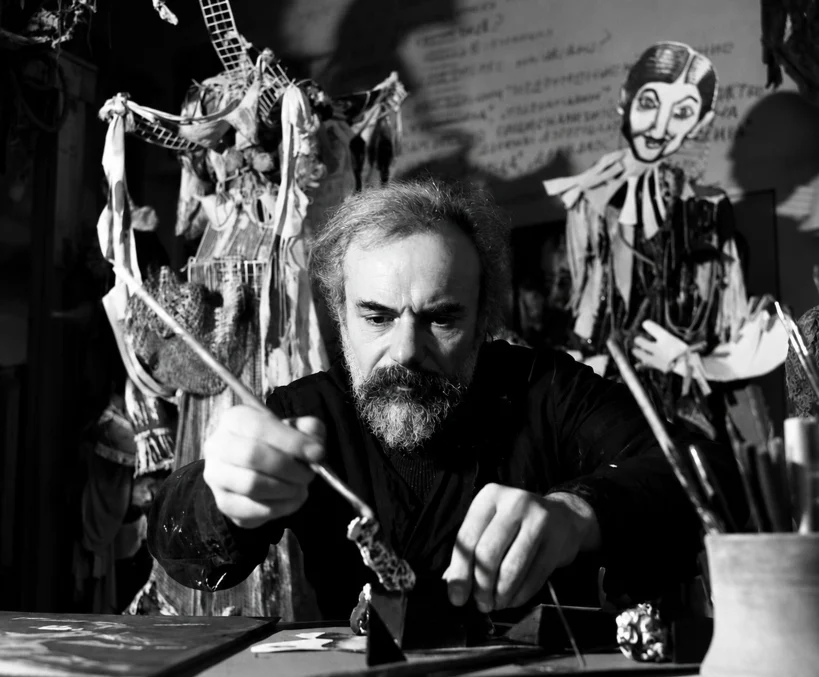
In the history of Armenian contemporary art, Henrik Igityan's contribution cannot be measured solely through his roles as an art historian, museum founder, or cultural figure. The recollections of those who knew him best reveal a personality whose influence extended far beyond the realm of art, shaping the country's entire cultural landscape. Among these testimonies, the reflections of painter and sculptor Henrik Elibekyan stand out, portraying Igityan as a symbol of intellectual freedom, artistic courage, and visionary cultural leadership.
According to Elibekyan, 1956 marked one of the most significant periods in Igityan's creative development. While studying acting and directing in Tbilisi, he also attended painting classes taught by the distinguished artist Valery Shukhayev. Elibekyan recalls these years as a time of profound self-discovery, during which Igityan sought to unite painting, sculpture, and theatre into a personal artistic language. Under the ideological restrictions of the Soviet regime, however, this search often became a struggle for creative freedom and self-expression.
In 1962, Igityan moved to Yerevan and continued his studies at the Faculty of Painting. According to Elibekyan, it was here that encounters with Minas Avetisyan and Yervand Kochar fundamentally shaped his artistic worldview. These relationships not only broadened his creative horizons but also laid the foundations for his future cultural mission.
Reflecting on this period, Elibekyan also recalls Igityan's series "Man in Space," created in an artistic language closely related to Pop Art aesthetics. Although the works were exhibited only years later, they provoked considerable public attention and became one of the boldest artistic statements of their time.
Yet, as Henrik Elibekyan emphasizes, Igityan's greatest achievement was not limited to his own artistic production. His true mission was to create a free platform for Armenian contemporary art. Together with Yervand Kochar, Minas Avetisyan, and a circle of progressive artists, he helped establish an environment in which Armenian art could be viewed within the broader context of international cultural developments.
Elibekyan speaks with particular admiration of Igityan's exceptional organizational talent, stressing that it was through his determination, broad cultural vision, and diplomatic skills that the Museum of Modern Art in Yerevan was founded in 1972—the first museum of contemporary art in the Soviet Union. In Elibekyan's view, this marked a turning point not only for Armenia but for the entire Soviet cultural sphere, as contemporary art was finally granted its own institutional home.
Elibekyan's recollections also highlight Igityan's theoretical contributions to art. Inspired by Yervand Kochar's concept of spatial art, Igityan developed his own system entitled "Painting and Sculpture in Space," based on the interaction of form, colour, movement, and space. According to Elibekyan, this theory sought to transcend the traditional boundaries between painting and sculpture, presenting art as a unified spatial phenomenon.
For Henrik Elibekyan, Igityan was also a guardian of cultural continuity. He believed that genuine innovation emerges not from rejecting tradition but from understanding it deeply and carrying it forward creatively. Igityan embodied this philosophy through his artistic practice, his institutional work, and his dedication to younger generations of artists.
Today, Henrik Elibekyan's recollections represent more than historical memories; they offer a unique portrait of Henrik Igityan through the eyes of one of his contemporaries. They reveal an individual who successfully united the roles of artist, thinker, and cultural leader, leaving behind a legacy that continues to shape the identity of Armenian contemporary art.