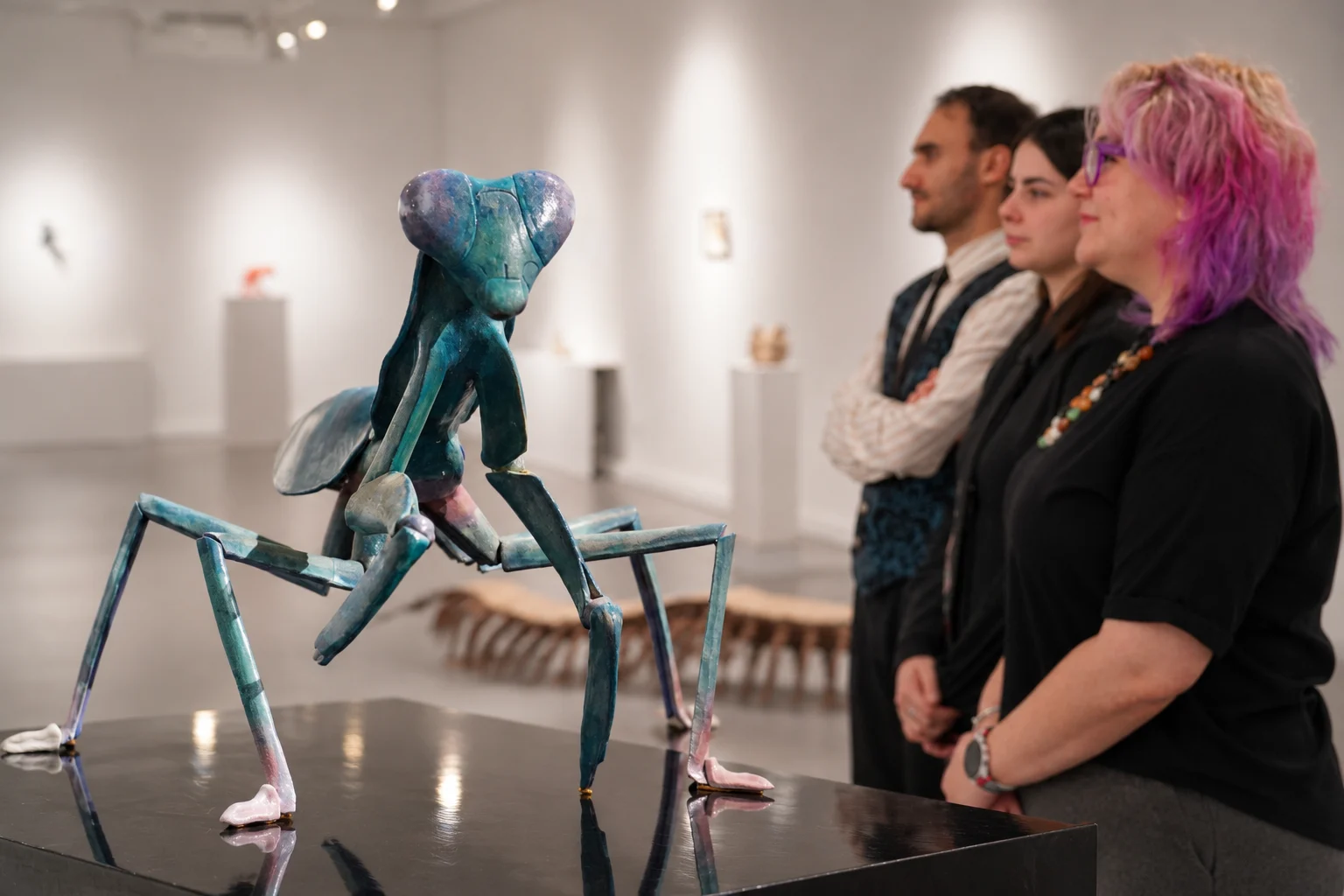
The human inner world is a space in which emotions, memories, experiences, and inner contradictions are constantly transforming, forming a complex and multifaceted system of individual perceptions. Often invisible, difficult to articulate, and elusive, these inner states can nevertheless acquire visible form, material presence, and an independent artistic expression through the language of art. It is precisely this conceptual ground that underpins the exhibition “Psychomorphosis,” inviting viewers to explore the distinctive relationship between inner states and their external manifestations.
In the works of Gayane Babayan, Alisa Astvatsatryan, and Vahagn Hayrapetyan, students of the State Academy of Fine Arts of Armenia, psychological experiences are transformed into tangible artistic forms. Ceramics, glass, and metal become not merely mediums of creative expression but materials through which the inner world is symbolically embodied. Each material, with its inherent qualities and expressive possibilities, introduces new layers of meaning into the works, revealing the fragility, resilience, contradictions, and transformative nature of human emotions. The very concept of “Psychomorphosis” suggests an inner transformation and the metamorphosis of psychological states. In the exhibited works, this process unfolds through the relationship between material and idea. The invisible acquires volume, boundaries, and structure, while abstract experiences become perceptible artistic realities. Thus, the works not only reflect the artists’ individual perceptions of the world but also establish a dialogue with the viewer, allowing each person to interpret what they encounter through their own emotional experience. The formative possibilities of ceramics, the transparency and fragility of glass, and the strength and material expressiveness of metal acquire particular artistic significance throughout the exhibition. These materials seem to become metaphors for different emotional states, expressing what often cannot be conveyed through words. Here, form is more than an external structure: it is an extension of the idea, while material becomes an independent language through which inner experiences find expression. Another significant aspect of the exhibition is the opportunity to discover the creative thinking and individual artistic languages of emerging artists. Their works reveal a willingness to experiment with materials, explore form, and develop distinctive means of expression. These explorations demonstrate an interest in the possibilities of contemporary sculpture and decorative-applied arts, while highlighting the creative independence of a new generation of artists. Supporting emerging artists and presenting their creative potential to the public is an important cultural priority for the Yerevan Museum of Modern Art. Providing students of the State Academy of Fine Arts of Armenia with an opportunity to exhibit their works within the museum is another step towards strengthening the connection between educational and cultural institutions, discovering new artistic voices, and contributing to the development of contemporary art. “Psychomorphosis” is more than a combination of materials and forms. It is an attempt to make visible the complex and often contradictory structure of the human inner world and to reveal expressions of emotion that transcend the boundaries of verbal communication. The exhibition reminds us that art can serve as a bridge between the invisible and the visible, between individual experience and universal emotional perception. And when emotions take on a physical form, material is no longer merely material: it becomes an artistic language that tells the story of the human inner world.Projects
“Psychomorphosis”: When Emotions Take on a Material Form
21.11.2026
The human inner world is a space in which emotions, memories, experiences, and inner contradictions are constantly transforming, forming a complex and multifaceted system of individual perceptions.