“Dream, Art, Yerevan”: A Dialogue of Memory, Identity, and Vision
29.09.2026
Maral and Jirair Panossian
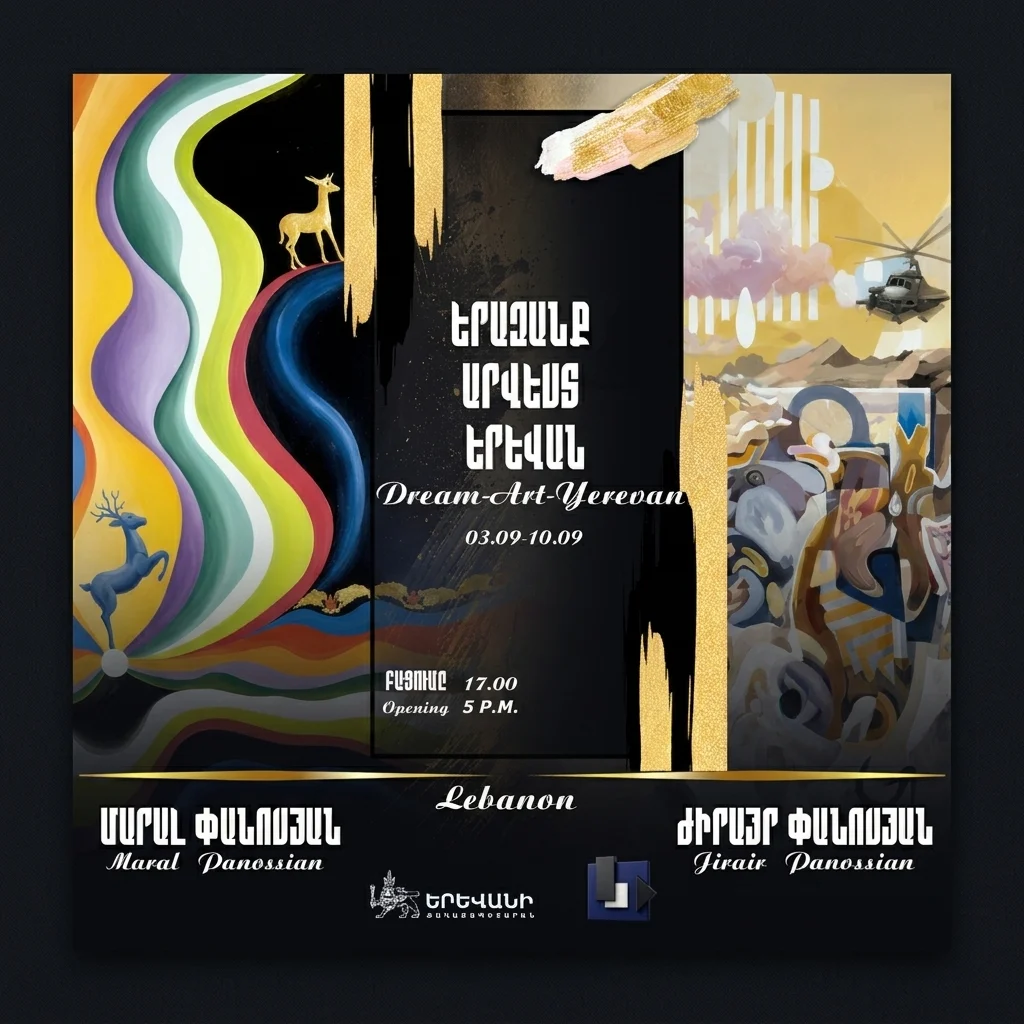
From September 5 to 10, the Yerevan Museum of Modern Art presented “Dream, Art, Yerevan”, an exhibition by Lebanese-Armenian artists Maral and Girair Panossian. The exhibition brought their artistic world to Yerevan, creating a space for dialogue in which personal memory, cultural heritage, urban experience, and imagination converge within a shared artistic language.
The founders of the AYP to ZED Art Academy, Maral and Girair Panossian have devoted more than two decades to art education while simultaneously developing their individual artistic practices. Their work is grounded in an exploration of the relationship between the human inner world, the surrounding environment, and memory.
Maral Panossian: Narratives Through Details
Maral Panossian’s painting is built upon an interplay between narrative and symbolism. In her works, seemingly ordinary scenes become spaces of memory, while familiar details are transformed into carriers of personal stories.
Working primarily in oil, Panossian uses color not merely as a visual device, but also as a vehicle for emotional and sensory memory. Recurring details form a distinctive system of personal signs within her compositions. Among them, the white dot and the deer occupy a particularly significant place, reappearing across different works as symbols charged with personal and emotional meaning.
The white dot may be perceived as an accent, a small presence of light, or a detail preserved within memory, while the deer can evoke sensitivity, delicacy, and inner freedom. Yet one of the defining qualities of Panossian’s art is that these signs are not confined to a single predetermined interpretation. Instead, they invite viewers to establish their own associations and connections with the work.
For Panossian, therefore, painting becomes not simply a representation of the visible world, but a means of reconstructing and preserving personal narratives.
Girair Panossian: Between Nature and the Rhythm of the City
Girair Panossian’s painting develops through a different rhythm. His works are shaped by the interaction between nature, the city, and the inner tensions of human experience. The urban environment is not merely a backdrop; it becomes a psychological space where movement, structures, human presence, and the intensity of contemporary life are transformed into visual experience.
Personal memories and emotions also occupy an important place in the artist’s work. Rather than being presented directly, they are translated into painterly forms, rhythms, and relationships of color. The canvas thus becomes a visual response to inner experience.
The influence of progressive rock music on Panossian’s artistic thinking is another important aspect of his practice. Much like musical composition, his works can be experienced through relationships of rhythm, repetition, tension, and resolution. If music creates a space through sound, Panossian translates these qualities into color, form, and movement.
From “Dream” to Yerevan
The title “Dream, Art, Yerevan” functions not only as the name of the exhibition but also as its conceptual axis. Dream can be understood here as a space where imagination and memory intersect; art as the visible expression of that inner world; and Yerevan as the place where these elements meet.
For Lebanese-Armenian artists, presenting their work in Yerevan also carries a dimension of cultural return. The diasporic experience and Armenian cultural memory are not presented as separate realities. Instead, they intersect and inform one another, shaping a multilayered understanding of identity.
In this sense, the exhibition can be viewed as a meeting point between two individual artistic languages within a shared cultural field. Maral Panossian’s work places particular emphasis on the details and symbols of memory, while Girair Panossian’s paintings more strongly foreground rhythm, movement, environmental tension, and inner energy. Their practices differ in their modes of expression, yet they converge in their exploration of the relationship between the individual, memory, and the surrounding world.
The exhibition at the Yerevan Museum of Modern Art thus became a space of encounter—not only between two artists, but also between different geographies, life experiences, and artistic perspectives.
“Dream, Art, Yerevan” reminds us that the journey of art often